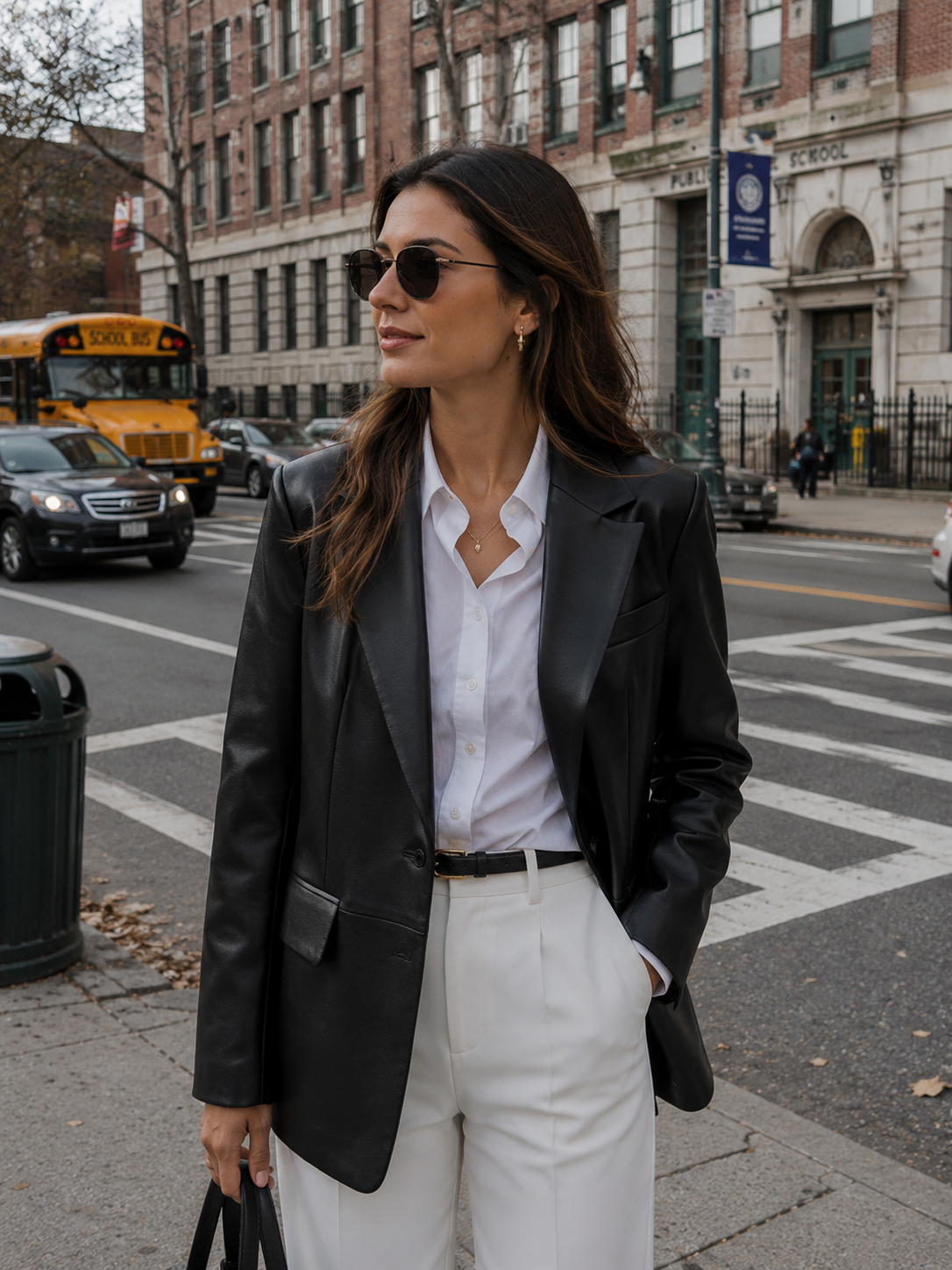
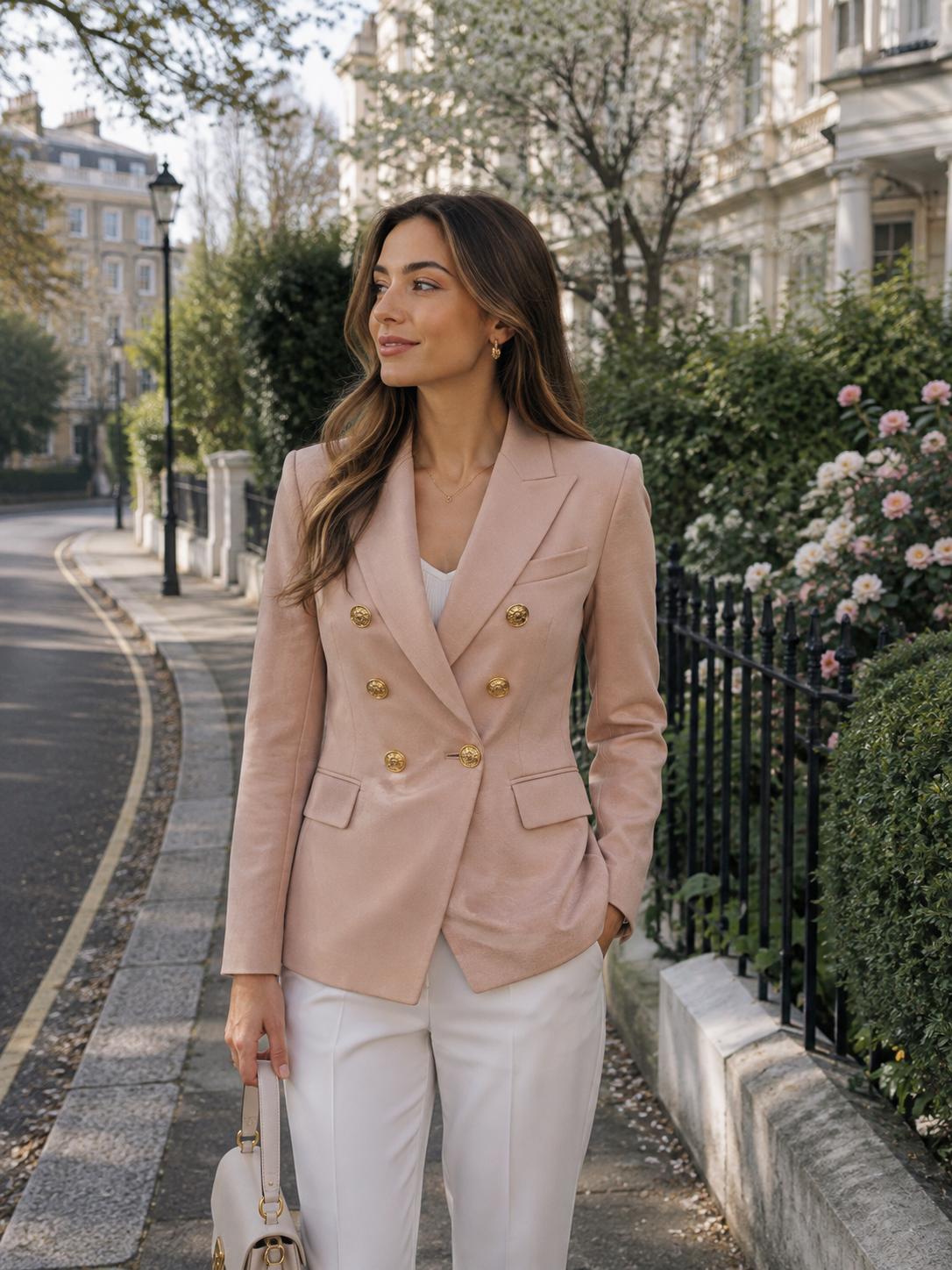
A blazer earns the name by carrying a jacket's full structure, a defined shoulder line, a lapel, a shaped body, without being cut to match a specific trouser the way a suit jacket is. Womens tailoring took that shape from menswear directly, and the fit conventions below still show that lineage even though the pattern underneath has been reworked from the ground up. Marco Jacket's current lineup runs the idea across genuine leather and lightweight wool-blend fabric rather than sticking to one material, which is closer to how the garment actually sits in stores today than a single-fabric approach would be.
How a Tailored Jacket Crossed Over Into Womenswear
Gabrielle Chanel began putting women into a fitted wool jacket in the mid-1920s, built with almost no boning or heavy interfacing so it moved with the body instead of holding it rigid the way a corseted silhouette had, and she borrowed the fabric and cut from menswear on purpose rather than softening it into something obviously feminine. Roughly four decades later, Yves Saint Laurent's 1966 "Le Smoking" took that borrowing further, adapting a mens tuxedo jacket into a fitted womens evening piece with a narrowed waist and a softened collar, a moment fashion historians widely credit as a turning point for women wearing tailored jackets as outerwear rather than as costume. The style resurfaced again in the shoulder-padded power blazer of the 1970s and 1980s, worn as a visual signal of authority as more women entered corporate workplaces, a look strongly associated with designer Claude Montana's padded shoulder line and popularized further by the "dress for success" advice books of that era. The blazer's own name and earliest boating-jacket origin is a shared piece of history across both the mens and womens sides of the category, covered in full on the mens blazers page rather than repeated here.
Where Womens Tailoring Actually Departs From a Mens Pattern
A mens blazer pattern is drafted close to straight through the torso and relies mainly on the shoulder and chest for shape, since a mens body typically doesn't need much waist suppression to read as fitted. A womens blazer pattern adds waist and bust darts, usually run from the side seam or the armhole rather than straight down the front, specifically to follow a curved waist-to-hip line that a straight-cut mens pattern was never drafted to handle. Sleeves and shoulders scale down proportionally too, set narrower and higher on the shoulder point so the garment doesn't borrow the wider frame a mens jacket is built around. Button closures also run in the opposite direction by long-standing convention, right side over left on a womens jacket versus left over right on a mens one, a holdover tailoring historians trace back centuries with no single settled explanation, though it's routine enough today that it barely registers as a design choice rather than just how a womens jacket is made.
Structured, Oversized, or Longline: The Silhouettes in This Category Right Now
The Womens Pink Leather Blazer keeps the fit close, a fitted waist and defined shoulder built from genuine leather in a bold pink that carries the tailoring itself rather than leaning on a printed pattern to do the work. The Women Black Oversized Leather Coat Blazer takes the opposite approach on purpose, running longer and roomier through the body while still keeping true blazer lapels and structured shoulders rather than softening into a plain coat collar, which is exactly what keeps it filed here rather than exclusively among leather coats. Sized true to its own numbers instead of the tighter fit of the pink piece, it reads as a blazer that was deliberately scaled up rather than a coat that happens to have lapels. The Womens Mint Green Blazer and Womens Blue Striped Blazer both use a lighter wool-blend construction instead of hide, sharp shoulder lines, a fitted waist, and a longline button-front cut built to work equally well buttoned closed or worn open over something underneath.
Lapels and Buttons on a Womens Blazer
A notch lapel, the small angled break where the collar folds into the lapel, is still the most common shape on a womens blazer for the same reason it dominates menswear: it works across the widest range of proportions and doesn't call attention to itself. Structured lapels sit at the core of what separates a real blazer from a soft, collarless cardigan-style jacket, since the lapel roll is one of the harder details to fake without an interlining doing real work underneath the cloth. Button count tends to run lower on a womens blazer than a mens one, frequently a single button rather than two or three, partly because the higher button stance that single-button styling allows tends to elongate the torso in a way that suits a fitted waist better than a lower stance would. None of the four pieces currently in this lineup publish an exact button count as a stated spec, so that detail is worth checking on the individual product page if it's the deciding factor.
Blazer Versus Suit: Why a Matched Set Lives Elsewhere
The line between the two comes down to what the jacket was cut alongside. A suit jacket is produced from the same cloth as its matching trousers or skirt in one run, meant to be worn as that pair and nothing else. A blazer carries the same structured shoulder and shaped waist but was never cut to match anything specific, which is what lets it move between a blouse and dark denim just as easily as it pairs with tailored trousers. That's exactly why Marco Jacket lists matched jacket-and-bottom sets under a separate suits heading instead of here: a piece from this page is styled against clothing a customer already has in their closet, not a bottom manufactured to accompany it.
Leather Versus Wool-Blend: Why the Two Fabrics in This Lineup Behave Differently
Leather holds a shoulder line on its own once it's shaped, since the hide itself has enough body to keep a structured silhouette without much help from an interior canvas, which is part of why the pink blazer and the oversized coat blazer both read as firmly structured pieces straight out of the box. A wool-blend jacket like the mint green and striped pieces relies more on an interior interlining and pressing to hold that same shoulder shape, and it drapes and creases differently against the body as a result, generally softer through movement than a leather equivalent. That difference in behavior is also why the two fabric families carry entirely different care routines rather than one shared set of instructions.
Fit Notes Before Ordering
Getting a structured blazer right comes down to two spots specifically, the shoulder seam and the waist taper, and a garment built around those two points forgives a slightly-off measurement far less than a loose, unstructured jacket would. The four styles here run a mix of size ranges, XS through 5XL on the two leather pieces and XS through 3XL on the wool-blend pair, and anyone landing outside those numbers or between two sizes can write to sales@marcojacket.com with their measurements ahead of placing an order to find out what each pattern can flex to accommodate. A build where the color, lining, and hardware are chosen individually rather than picked from an existing listing runs through the separate custom leather jacket page instead, since that service is built around style selection rather than the sizing questions covered here.
Caring for Leather and Wool-Blend Pieces Side by Side
The leather pieces need a barely damp cloth for surface dirt and a leather conditioner worked in every few months so the hide doesn't dry out and crack along the fold lines, kept on a padded or shaped hanger rather than a wire one and out of direct sun for long stretches since UV exposure dries and fades hide faster than most other damage. The mint green and striped wool-blend blazers are better handled through dry cleaning rather than a home wash, since the structured shoulder and pressed lapel can lose their shape in a washing machine even when the fabric itself would technically survive it. Anyone weighing a smooth-grain leather jacket instead of the blazer's tailored cut can browse womens leather jackets for that same hide in a looser, non-tailored silhouette.
Frequently Asked Questions
Is everything in this category made after I order or is any of it in stock?
Yes, every blazer currently listed here is cut and finished after an order comes in rather than pulled from finished stock kept on hand.
What makes a womens blazer different from a mens blazer?
The shape underneath, mainly. A womens blazer pattern adds waist and bust shaping that follows a curved waistline, narrower shoulders and sleeves scaled to a different frame, and a button closure that runs the opposite direction from a mens jacket by long-standing convention.
Is the oversized leather coat blazer meant to be worn like a coat or a blazer?
Either, depending on what's needed. It keeps true blazer lapels and structured shoulders rather than a coat collar, but it's sized true to its own roomier proportions on purpose, so it works as a longer, looser blazer over a blouse or as a lighter outer layer in place of a full coat.
Whats the difference between a blazer and a suit jacket?
A suit jacket is cut from the same fabric as a matching trouser or skirt made in the same run. A blazer carries the same structured shoulder and shaped waist but was never cut to match a specific bottom, which is why it's kept separate from the suits listing here.
Do the leather and wool-blend blazers need different care?
Yes. The leather pieces need periodic conditioning and a damp cloth rather than washing, while the mint green and striped wool-blend blazers should go to a dry cleaner rather than a home washing machine so the shoulder structure holds its shape.
Can sizing be adjusted if my measurements dont match the standard chart?
It can be. Email sales@marcojacket.com with your numbers before placing the order so the team can confirm what a specific pattern allows.
How long does a made-to-order womens blazer take before it ships?
Between 10 and 12 business days is the typical stretch from placing an order to a blazer leaving the workshop, and whatever shipping method gets picked at checkout adds its own transit time on top of that window. That estimate can stretch further around a particularly busy stretch or a seasonal rush.
Does this category ship outside the United States?
Yes, Marco Jacket ships to a wide range of international destinations. The shipping and delivery policy page lists the carrier options and estimated transit windows involved.
What if a piece doesnt fit once it arrives?
The returns and refund policy page covers the 30-day return window and the condition items need to be in. Since these are cut to order rather than pulled from stock sizes, checking the chart closely before buying matters more than it would with off-the-rack sizing.