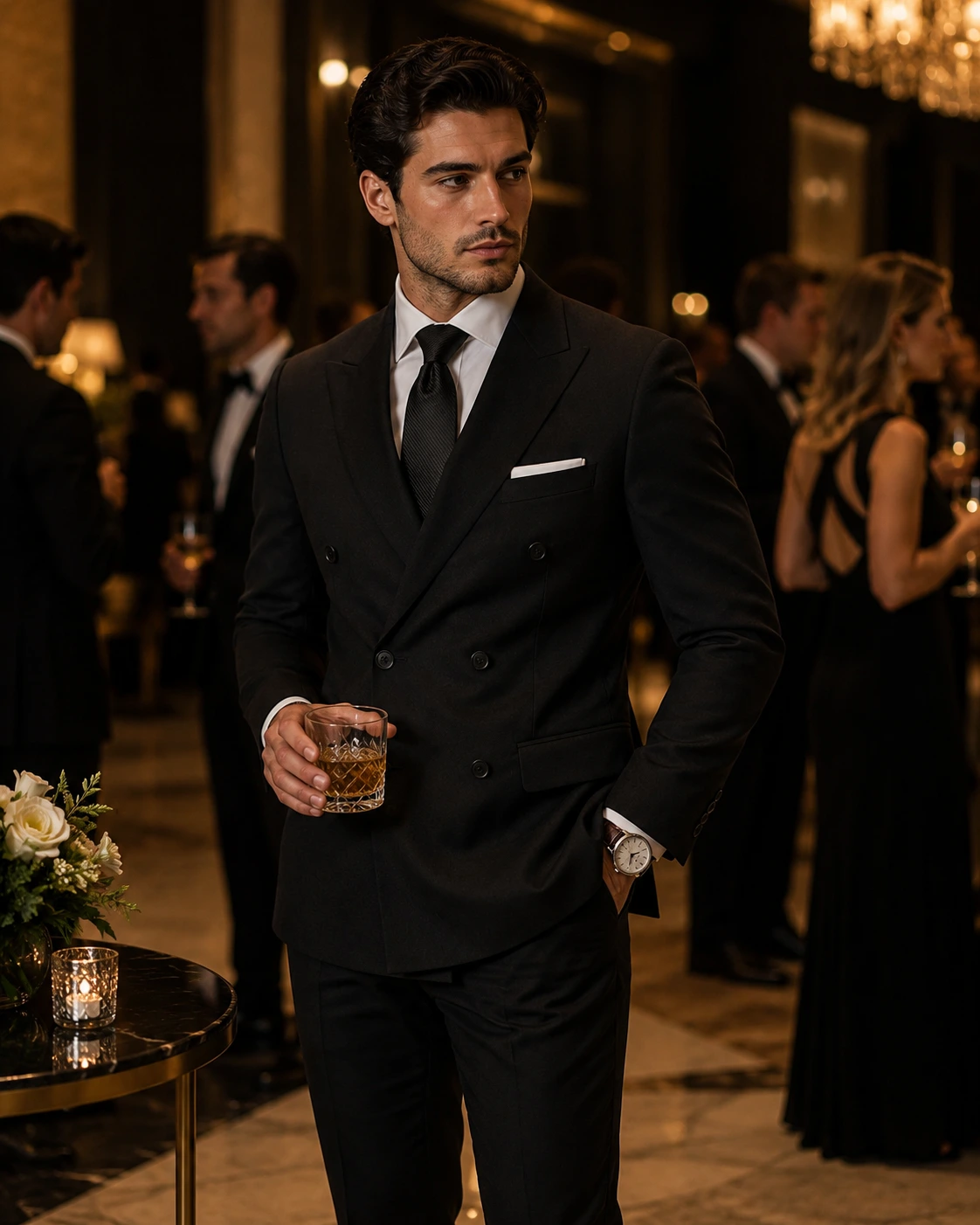
Every suit color carries some kind of signal, but black carries the strongest one. It is the color a suit turns to when the occasion has already decided the tone before anyone gets dressed, a funeral, a formal dinner, a courtroom, a stage. The black suit currently available at Marco Jacket is cut fresh for each order rather than pulled from finished stock sitting in a warehouse, so the fit notes and size chart on its own product page carry more weight than they would with a garment already finished and sitting on a shelf.
Why Black Became the Go-To Color for Solemn and Formal Occasions
Western mourning dress has leaned on black for well over a century, and the convention has outlasted most of the etiquette rules that originally surrounded it. Menswear guides still treat a black suit as the safest, most respectful choice for a funeral specifically, ahead of a black tuxedo, which reads as festive rather than somber no matter how dark the room is. Navy or charcoal are commonly cited as acceptable stand-ins when a black suit is not on hand, paired with muted accessories, but black itself remains the default precisely because it signals nothing except the occasion. That same quality, a color that refuses to compete with anything else in the room, is why black also shows up for evening formalwear and for fields where a suit is expected to disappear into the background rather than express personal style.
A Black Suit Is Not a Tuxedo, Even Though Both Look Dark From Across the Room
This is one of the more common mix-ups in menswear, and it is worth answering directly rather than glossing over. A tuxedo is a specific evening garment built around a handful of features a plain black suit does not have: lapels faced in satin or grosgrain rather than matching wool, jetted rather than flapped pockets, trousers finished without cuffs, and a waist meant to be covered by a cummerbund or waistcoat instead of left bare. A black suit keeps a self-faced lapel in the same cloth as the jacket, closer in spirit to a business suit that simply happens to be dark. Wearing a black suit to an event with a stated black tie dress code reads as underdressed to anyone who knows what to look for, and the reverse is just as true, a full tuxedo shows up as overdressed anywhere a black suit was the actual expectation. That's the reason evening formalwear gets its own dedicated tuxedos listing on this site rather than living inside black suits: an invitation that actually says black tie calls for a trip to that page instead, not a dark suit pulled from here.
Jet Black, True Black, and Cloth That Only Reads Black Indoors
Not every fabric sold as black behaves the same way once it leaves the shop. Higher-quality suiting is generally solution-dyed or dyed with the pigment worked deep into the fiber, which holds a dense, even black through repeated wear and cleaning. Cheaper cloth is more often surface-dyed, meaning the color sits closer to the outside of the fiber and wears thin faster, which is part of why an older black suit can start to pick up a brownish or slightly purplish cast under strong light long before it looks obviously worn anywhere else. Lighting plays its own trick on top of that: a genuinely black cloth and a very dark navy can look identical under indoor incandescent bulbs, only to separate clearly once compared in daylight, which is a common enough mix-up that menswear forums have entire threads dedicated to telling the two apart at a glance. None of this is a defect specific to any one suit; it is simply how dark, dyed wool behaves, and it is worth knowing before assuming a suit has gone off-color when it may just be sitting under the wrong bulb.
Solid Black Versus Black With a Woven Texture
A flat, plain-weave black suit is the most formal version of the color and the one that reads as pure solid from any distance, which is exactly what a funeral or a formal evening calls for. Fine self-textured weaves, birdseye's small repeating dot, a tight herringbone's subtle zigzag, or nailhead's pinpoint two-tone weave, still read as essentially solid black across a room while showing depth and a bit of shine variation up close. That texture does not cost the fabric its formality the way an obvious pattern would; the rule of thumb among tailors is that the finer and smaller the weave, the more formal ground it holds onto. A bolder black-based check or a heavily textured cloth like corduroy moves black away from funeral-and-boardroom territory and toward something closer to smart-casual, which is a different use case than most shoppers landing on this category are actually after.
Should a Black Suit Ever Go to a Job Interview?
It depends more on the room than the color itself. Career-focused menswear guides generally steer interview dressing toward navy or charcoal first, on the reasoning that black can carry an unintentionally somber or overly severe note in a setting meant to project approachability and competence rather than gravity. That guidance shifts for conservative fields, law, finance, and government among them, where a clean black suit rarely reads as wrong, and it shifts again for an interview scheduled around an evening event or a more formal industry norm. The safer general instinct is to treat black as the correct call once the occasion is unambiguously formal or solemn, and to lean navy or charcoal when the goal is simply to look sharp and approachable for a daytime meeting.
The Double-Breasted Cut Currently Available in Black
Right now this category holds one confirmed black style, a double-breasted suit set built with a slim, tailored fit. Rather than the roomier drape some overlapping jackets carry, this cut is meant to sit close through the chest and follow the body's actual shape, which is the more contemporary way to wear that crossover front without it reading dated or boxy. It comes in sizes from XS through 5XL with custom sizing available for anyone outside that range, and it calls for dry cleaning only, the standard care instruction for structured suiting rather than anything unique to black cloth specifically. Anyone who wants to see that same front construction across other colors and patterns can browse the dedicated double-breasted suits listing.
Getting a Black Suit's Fit Right When Nothing Is Held in Stock
A double-breasted front is less forgiving of an inaccurate measurement than a single-breasted one, since an overlapping panel that sits even slightly off shows up faster across the chest, and black cloth in particular gives fit problems nowhere to hide the way a busier pattern might. Because the black suit currently listed here is cut only once an order comes in, the chest, shoulder, and waist figures entered at checkout matter more than they would with a finished garment pulled off a rack. If a measurement falls outside the printed size run, writing in with specific numbers before ordering lets the team confirm what can be adjusted for that particular cut, rather than guessing after the fact once cloth has already been cut.
Frequently Asked Questions
Is everything in this category made after I order or is any of it in stock?
Yes, the black suit listed here is cut and assembled after an order is placed rather than pulled from finished inventory. There is no black suit stock held on hand for immediate shipping.
Is a black suit the same thing as a tuxedo?
No. A tuxedo has satin or grosgrain lapel facing, jetted pockets, no trouser cuffs, and a covered waist, all built specifically for black tie dress codes. A black suit keeps a lapel in the same fabric as the jacket and a build meant for general use, closer to a dark business suit than to formal evening wear.
Can a black suit be worn to a job interview?
It depends on the field and the setting. Conservative industries like law, finance, or government rarely penalize a clean black suit, but general interview guidance more often points toward navy or charcoal for a daytime meeting, since black can read as more severe than the situation calls for.
Is a black suit appropriate for a funeral?
Yes, and it is generally treated as the most respectful default choice for funeral attire specifically. Navy or charcoal are the usual fallback if a black suit is not available, but a black tuxedo is not a substitute, since it reads as festive rather than somber.
Why do some black suits look slightly brown, purple, or faded next to a newer one?
It usually comes down to how deeply the dye penetrated the fiber in the first place. Cloth that is dyed only on the surface fades faster and can pick up a brownish or purplish undertone with repeated wear and cleaning, while more deeply dyed wool tends to hold an even black for longer.
Is this black suit single-breasted or double-breasted?
Double-breasted, with two columns of buttons across an overlapping front and a slim, tailored fit through the body rather than a looser drape.
Can sizing be adjusted if my measurements don't match the standard chart?
Yes. Write in with the specific measurements that fall outside the printed chart before placing the order so the team can confirm what is adjustable for this particular cut.
Does this category ship outside the United States?
Yes, shipping is available to a wide range of international destinations. The shipping and delivery policy page covers carrier options, transit windows, and address types some carriers cannot service.
What if a suit doesn't fit once it arrives?
The returns and refund policy page covers the return window and the condition items need to be in. Since this suit is cut per order rather than pulled from stock, checking the size chart twice before ordering matters more than it would with standard shelf sizing.