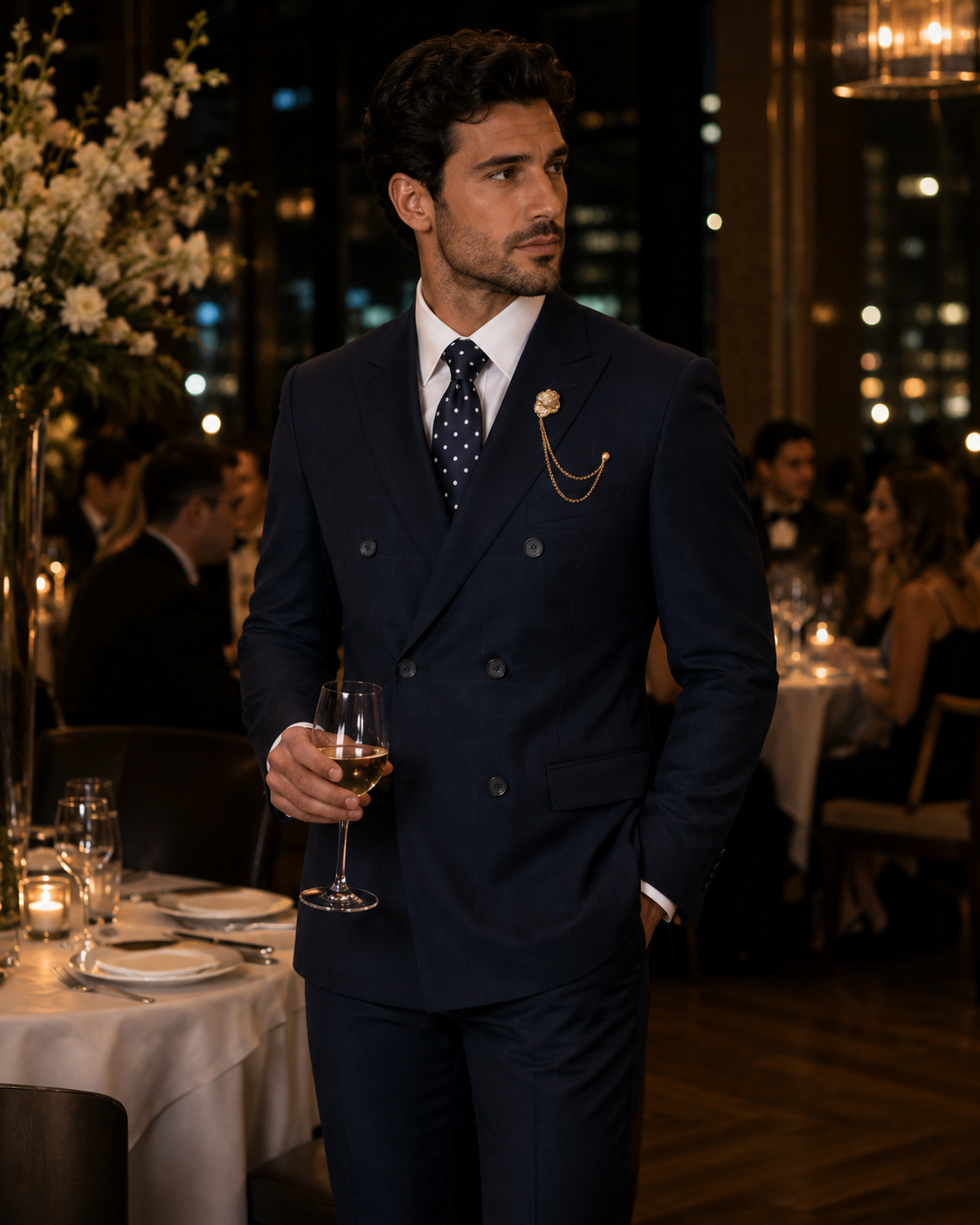
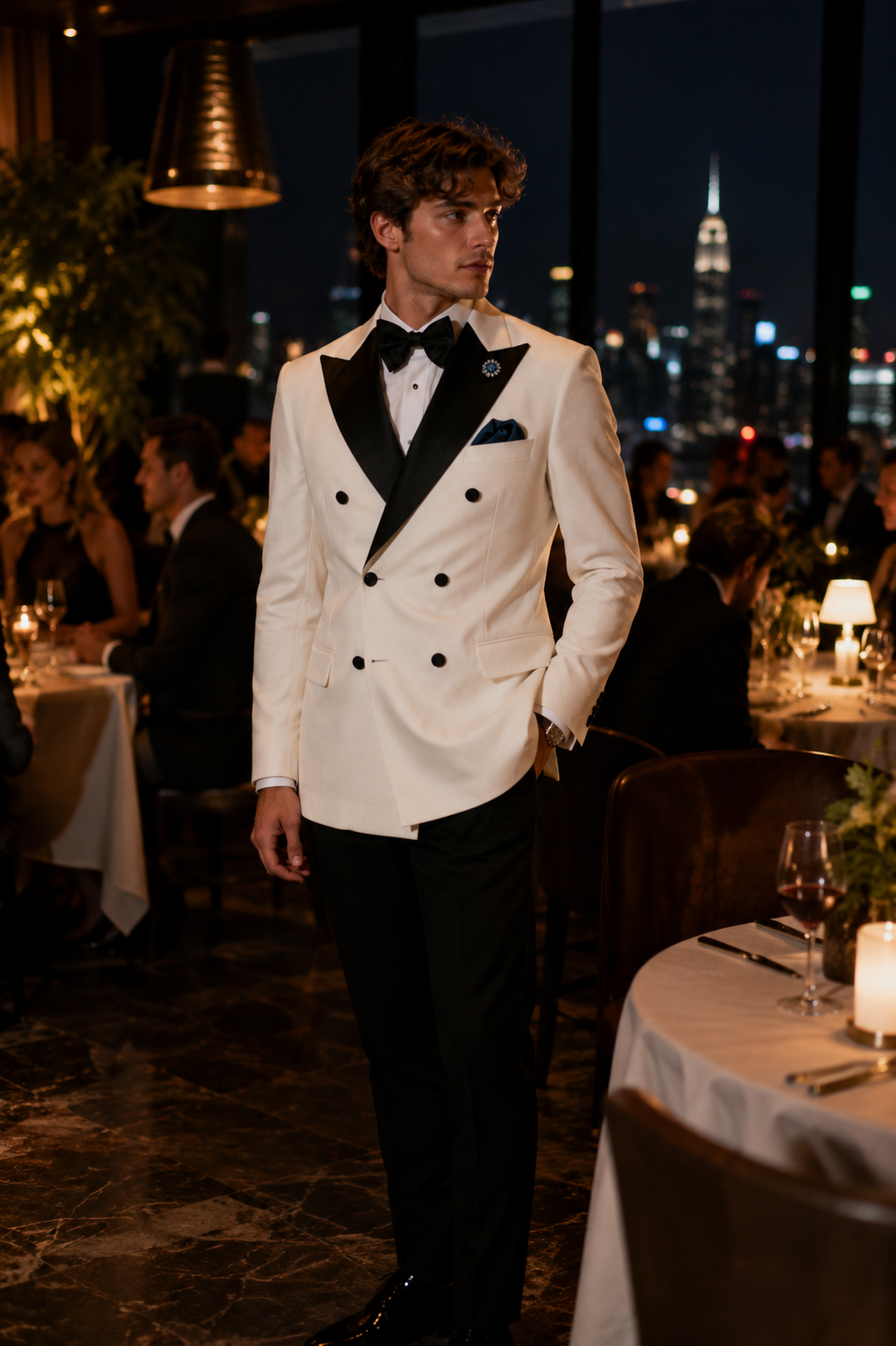
A double breasted suit is defined by one structural choice: the front panels cross over each other far enough to carry two full columns of buttons instead of one, and that crossover has outlasted more fashion cycles than almost any other tailoring detail still in regular use. It reads as more formal than a single column jacket cut from the same cloth, it photographs differently under light because of the extra fabric stacked across the chest, and it has moved between naval wear, business tailoring, and eveningwear more than once over the past century without ever fully disappearing from any of them.
A Sailor's Jacket That Wandered Onto Land
The crossover front has naval roots, tracing back to the reefer jacket worn by officers, a short, heavy coat cut to close snugly against wind and spray with a doubled front for extra warmth rather than for style. Civilian tailors picked up the same construction in the early twentieth century, first as a looser, sportier alternative worn over tennis whites and seaside clothing, then gradually as something a man might wear into an office or an evening event once looser dress codes made room for it. What had been a practical maritime garment turned into a genuine alternative to the stiffer three-piece wool suit, in part because it let a man skip the waistcoat entirely while still covering the shirt front the way a waistcoat would have.
Six Buttons, One or Two Fastenings
Most double breasted jackets show six buttons across the front, but only one or two of them actually close anything, and that distinction matters more than it looks. A 6x2 layout fastens at two points, one near the natural waist and one below it, and it remains the more traditional, slightly more formal version of the two. A 6x1 layout keeps the same six buttons visible but closes only at the lower point, which opens the lapel line further and reads as a touch more relaxed. That single-button version is usually credited to Edward VIII's own tailoring choices during the years between the world wars, when he wore it enough that the style picked up his name informally among tailors long after he stopped being king. A jacket built with a true 6x2 front will have a working buttonhole hidden on the underside of the top overlap even though that upper button is never actually meant to be fastened in daily wear, since sewing it shut would pull the lapel roll out of shape.
Out of Fashion, Back In, Out Again
The style had its clearest moment in the 1920s and 1930s, when a run of well-dressed public figures wore it enough that a wider audience followed, and tailors on both sides of the Atlantic leaned into wide peak lapels and a longer jacket line to go with it. That popularity did not hold. Through the 1960s, a plainer, trimmer single breasted silhouette took over as the dominant look, and the crossover front largely disappeared from everyday wardrobes for the better part of two decades. It came back hard in the 1980s, though that decade's version leaned into oversized shoulders and wide lapels that now read as distinctly dated rather than timeless. The version cut today has walked that excess back considerably, closer to the body, with a more natural shoulder line than either the 1930s or 1980s versions wore.
A British Front and an Italian Front Aren't Cut the Same Way
Two regional tailoring traditions treat the same crossover front quite differently. A British approach tends to build in a firmer canvas layer and a padded shoulder, producing a squared, upright line that reads as authoritative rather than relaxed, historically the choice for business and government settings where a sharper silhouette carries its own signal. An Italian approach, particularly the Neapolitan school, uses a lighter or unpadded shoulder and a softer canvas, letting the jacket fall closer to the body's own shape rather than imposing a stiffer one over it. Both traditions still put the crossover front to work, but the same double breasted layout can read as either buttoned up or relaxed depending entirely on which construction tradition shaped the shoulder and chest underneath it.
Why a Peak Lapel Almost Always Shows Up Here
A peak lapel, the version that angles up toward the shoulder seam rather than breaking at a small notch, pairs with a crossover front for a reason rooted in proportion rather than tradition alone. The extra fabric stacked across a double breasted chest adds visual weight low on the jacket, and a peak lapel's upward angle pulls the eye back toward the shoulder line to balance it, which is part of why the style was already showing up on double breasted jackets during its first major run in the interwar years and never really left. A notch lapel on the same crossover front tends to look slightly undersized next to all that extra fabric, which is one reason the pairing has held for as long as it has rather than being an arbitrary styling rule.
One Front Style, Two Very Different Dress Codes
The crossover front is a construction choice, not an occasion, which is why it shows up on both business suits and formalwear without contradiction. The white two piece tuxedo currently in this lineup carries the same two column closure as the navy pinstripe suit a few listings over, but its textured white fabric and structured button closure are built for a wedding, gala, or formal evening rather than a workday, and it deliberately skips the black or navy most formalwear defaults to. Anyone shopping specifically for that kind of formal piece should also check the tuxedos listing and the white suits listing, both of which cover that same white tuxedo from an occasion angle rather than a construction angle.
The Double Breasted Styles Currently in the Lineup
The navy pinstripe suit keeps its pattern subtle rather than bold, present enough to read as texture without turning into a loud stripe, and pairs it with a regular fit and an adjustable waistband on the trousers for some built-in give at the fitting stage. The navy glen plaid suit swaps the pinstripe for a check historically tied to Scottish tweed and old-world tailoring, distinct up close without reading as costume-like at a normal conversational distance. The light gray suit is built for a daytime formal event that calls for something lighter than black or navy, an outdoor wedding or a daytime reception being the clearest examples. The white tuxedo mentioned above rounds out the current spread by covering the formal evening end that none of the other three touch. More cuts, patterns, and colors get added to this listing over time, so treat this as what's currently available rather than the full range the crossover front can be found in here.
Getting the Overlap to Sit Right
A double breasted jacket that fits well closes flat against the chest with the lapel rolling smoothly down to the working button, and a jacket cut even slightly too large will show a gap or a bulge right where that overlap sits, more visibly than the same sizing error would show on a narrower single column front. Jacket length matters more here too, since a crossover front cut too short exposes the fastening point in a way that reads as unfinished rather than intentional, while one cut too long buries it. All four double breasted styles currently listed run from XS through 5XL with custom sizing available beyond that standard chart, and getting an accurate chest, shoulder, and waist measurement before ordering matters more on this front style than on almost any other cut in the broader suits lineup.
Living With a Double Breasted Suit
Every style listed here calls for dry cleaning only, since the layered front and structured canvas underneath don't hold their shape well through a home wash cycle. A double breasted jacket is also meant to stay fastened at its working button whenever it's worn standing, both because the crossover front loses its clean line the moment it hangs open and because sitting down in one is easier with the jacket unbuttoned rather than fighting the extra fabric across the lap. Between wears, a wide, shaped hanger keeps the shoulder line from collapsing the way a thin wire hanger eventually causes on any structured jacket.
Frequently Asked Questions
What's the actual difference between a 6x2 and a 6x1 double breasted jacket?
Both show six buttons across the front, but a 6x2 closes at two points, one at the waist and one below it, while a 6x1 closes only at the lower point and leaves the lapel line more open. The 6x1 version reads slightly more relaxed and is commonly associated with tailoring from the interwar period.
Is a double breasted suit more formal than a single breasted one in the same fabric?
Generally yes. The crossover front and its extra fabric across the chest read as more deliberate and more formal even when the material and color are identical to a single breasted version, which is part of why it pairs so naturally with formal eveningwear as well as business suits.
Should a double breasted jacket be worn buttoned or open?
Buttoned while standing. The construction is built to sit flat with the working button fastened, and leaving it open tends to make the crossover front sag rather than hang cleanly. Sitting down is the one exception where unfastening it is normal and expected.
Is everything in this category made after I order or is any of it in stock?
Yes, every double breasted suit listed here is cut and sewn after an order comes in rather than pulled from finished stock kept in a warehouse.
Can sizing be adjusted if my measurements don't match the standard chart?
It can be. Send your chest, shoulder, and waist numbers to sales@marcojacket.com before placing an order so the team can confirm what the pattern allows for that specific style.
What if a suit doesn't fit once it arrives?
The returns and refund policy page covers the return window and the condition an item needs to be in. Since a double breasted front shows a poor fit more visibly than a single column jacket, checking the size chart closely before ordering is worth the extra few minutes.
Does this category ship outside the United States?
Yes, orders ship internationally. The shipping and delivery policy page lists carrier options and estimated transit windows by destination.
Is the double breasted suit dated, or is it still worn today?
It's currently worn, though today's cut is trimmer through the shoulder and body than either its 1930s or 1980s versions. The oversized 1980s take on the style is the version that reads dated now, not the crossover front itself.
Why does a double breasted jacket usually have a peak lapel instead of a notch lapel?
A peak lapel angles upward toward the shoulder, which helps balance the extra fabric a crossover front stacks across the chest. A notch lapel can look slightly undersized next to that same amount of fabric, which is why the peak pairing has stayed common on double breasted jackets for close to a century.