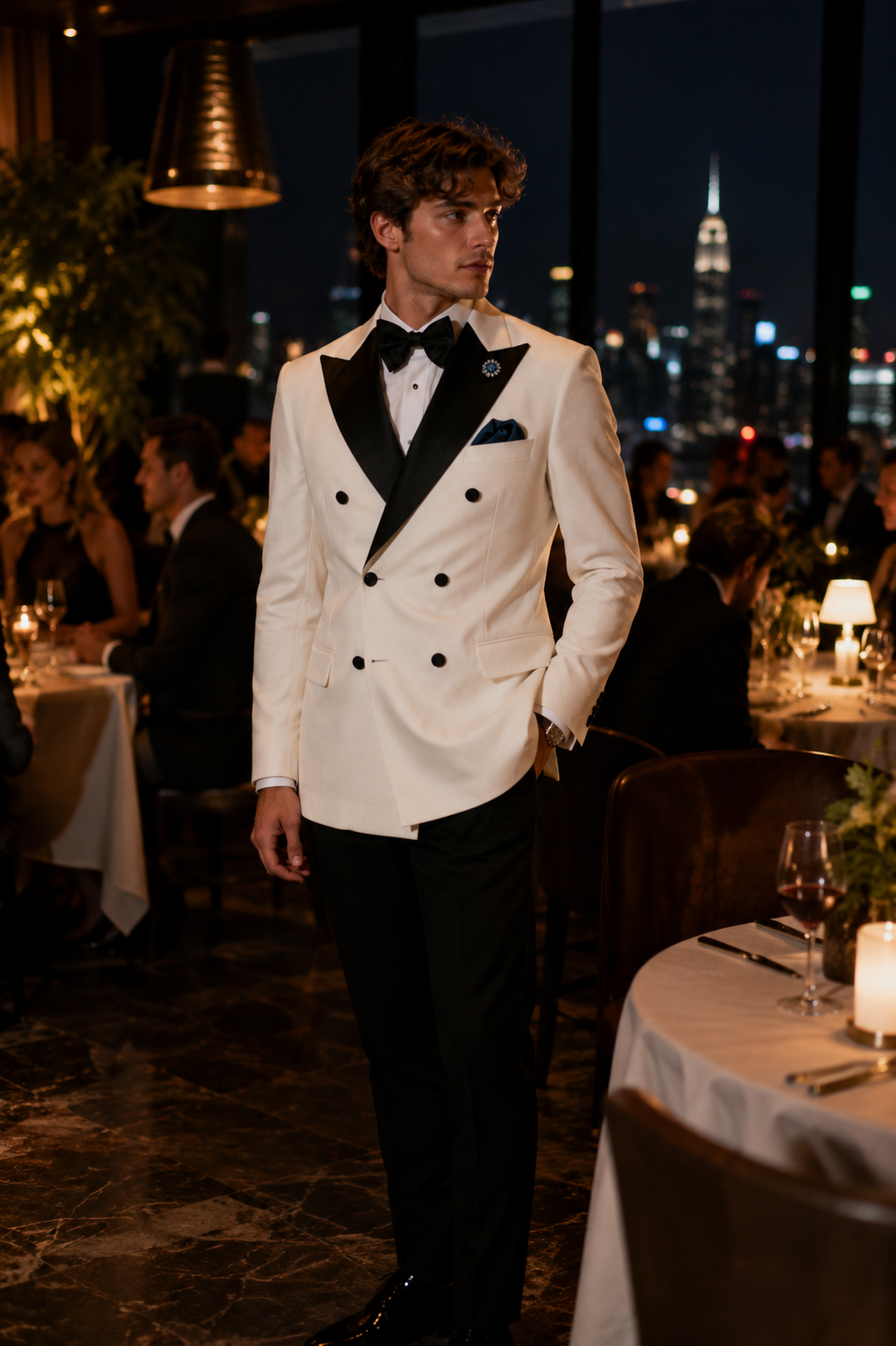
White does something no other suiting color does: it sits in two separate wardrobes at once. One is the pale summer business suit worn at a warm-weather wedding or a resort meeting, built from lightweight wool or cotton and treated as daytime tailoring. The other is the white dinner jacket, a formal evening garment with its own history and its own rules, worn after dark rather than during business hours. The style currently available at Marco Jacket, cut with an overlapping double-breasted front, sits on the evening side of that split, and the sections below cover both traditions honestly rather than blur them into one generic idea of "a white suit."
Where the White Dinner Jacket Actually Comes From
The light-colored dinner jacket did not start as a fashion statement, it started as a practical fix. In the early 1930s, well-off travelers heading to tropical and subtropical resorts wanted a way to dress formally for dinner without wearing the same heavy, dark wool that evening wear called for back home. A lighter jacket in white or a soft ivory shade solved that problem and became a fixture of warm-climate resort life through the decade. The look picked up serious cultural weight once film got hold of it: Humphrey Bogart wore a shawl-collar white dinner jacket as Rick Blaine in Casablanca in 1942, and Sean Connery's Goldfinger appearance in 1964 set the template that ran through several later Bond films. Neither actor invented the garment, both simply put a resort staple in front of a much larger audience than any tailor could reach on his own.
The Seasonal Rule, and Why It's Argued Over
Traditional formalwear guidance ties the white dinner jacket to warm weather specifically, and some sources translate that into a literal window running from Memorial Day to Labor Day, borrowed from a broader old rule about when white is acceptable at all. Others push back on a fixed calendar entirely and argue climate should decide it, not the date, since a jacket that reads perfectly at a beachfront wedding in Miami can look out of place at a formal dinner in a cold northern city regardless of what month it is. Even among people who take evening dress codes seriously, the style has drawn real criticism: British style writer Hardy Amies dismissed the white dinner jacket as unsuited to European formal settings. Treat the seasonal convention as a real but genuinely contested guideline rather than a fixed rule, and let the actual event, climate, and setting make the final call.
Suit or Tuxedo: Reading the Cut on the Page
The piece currently listed here is honestly a white tuxedo rather than a daytime business suit, and it is worth being direct about that distinction instead of stretching the word "suit" to cover both. Its own product page markets it for weddings, galas, and evening formal events, and describes the double-breasted construction as carrying more presence than a single-breasted cut, with structured shoulders and a stronger V shaped chest line built into the tailoring itself. That overlapping, two-column front has been part of formal menswear since early in the twentieth century, prized for exactly the squared-off, more deliberate silhouette this piece is built around. A shopper who specifically wants black tie should treat this as a genuine option, and one who wants the full spread of that same crossover construction in other colors can browse the wider double-breasted suits assortment.
All White vs the Traditional Black and White Combination
Classic white dinner jacket etiquette pairs the white jacket with black formal trousers carrying a satin side stripe, so contrast, not a head to toe white look, is the traditional formula. What Marco Jacket currently lists is a full matching set in white, jacket and trousers together, which follows a more contemporary approach that has become genuinely popular for grooms specifically, favored for photographing cleanly against most wedding palettes rather than for matching the older resort convention. Both approaches are legitimate; a shopper aiming for old-school black tie may prefer to source black trousers separately, while anyone after the current monochrome wedding look already has that covered in this one piece.
Why White Cloth Behaves Differently Than Any Other Suiting Color
White is the least forgiving color a tailor works with. Every seam, every pucker in the lining, any unevenness in how a panel was cut shows up faster on white than it would on navy or charcoal, where the same flaw would simply disappear into the depth of the color. Staining is the other obvious concern, a white jacket worn at a reception with open bars and passed hors d'oeuvres carries more risk than a dark one at the same event. A flat, single-note white cloth makes both problems worse, since there is nothing in the weave to break up the eye's attention. A textured white fabric, the kind used in the piece currently available here, works against that by catching light unevenly across its surface, which does double duty: it reads as a more considered fabric choice under evening lighting, and it is simply more forgiving of the ordinary handling a formal jacket goes through in one night's wear.
Why White Rarely Shows Up in Everyday Business Tailoring
A white or off-white suit was, for a period, treated as acceptable daytime wear adjacent to business in warm climates, more a marker of leisure than of anything strictly formal. That association is a large part of why white never became a staple business color the way navy and charcoal did: a dark suit reads as serious in almost any professional setting, while a white one reads as vacation or resort wear first. Lightweight white cloth also tends to hold up less well over repeated wear than a heavier flannel or gabardine in a darker shade, which discouraged treating it as an everyday office garment even when it was fashionable. None of that rules out a white suit for a genuinely warm climate business context or a destination wedding as a guest, it simply explains why ready racks of white business tailoring are much thinner than racks of navy and gray, and why the white suits lineup currently available here leans toward evening formalwear rather than daytime business cuts.
Fit, Fabric, and Sizing on the Piece Currently Available
The white tuxedo currently listed runs a size range from XS through 5XL, with custom sizing available on request for anyone outside that standard chart. Because the front panels overlap, an inaccurate chest or shoulder measurement is more visible here than it would be on a single-breasted jacket in the same fabric, the same rule that applies to double-breasted tailoring generally. It carries the structured, modern fit its own listing describes rather than the boxier drape of an older dinner jacket, so it sits closer to the body than a vintage cut of the same silhouette would.
Caring for a White Formal Piece Between Wears
This piece is dry-clean only, and that matters more with white cloth than with almost any other color, since home laundering risks both shrinkage and the kind of graying that never fully reverses. Address a spill or a mark as soon as it happens rather than waiting until the whole jacket goes in for cleaning, since a fresh stain lifts far more easily than one that has set. Store it on a proper shaped hanger with shoulder support inside a breathable garment bag, and keep it out of direct sunlight between wears, since prolonged light exposure is a real contributor to the yellowing that white and off-white fabric are prone to over time.
What "Currently Available" Means Here
White suiting spans a wide range, from a lightweight summer business cut to the evening dinner jacket tradition covered above, and this category is built to represent that full range over time rather than lock itself to whatever happens to be listed on a given day. The piece available right now leans toward the formalwear end of that spectrum, but the category itself is not defined by that single piece, and a daytime white business suit fits here just as naturally whenever one is added. Anyone after the broader suits assortment in general, including patterns and other crossover-front colorways, can start from the main suits listing instead.
Frequently Asked Questions
Is this a suit or a tuxedo?
The piece currently listed under white suits is honestly a tuxedo, built for weddings, galas, and evening formal events rather than daytime business wear. It is included in this category because of its color, white, but anyone specifically shopping for black tie should treat it as a tuxedo and browse the dedicated tuxedos category for the wider selection built specifically for that occasion.
Is a white suit the same thing as a white dinner jacket?
No. A white suit, in its original sense, is daytime or summer business tailoring, while a white dinner jacket is evening formalwear with its own separate history and etiquette. The two share a color, not an occasion, and mixing them up is one of the more common mistakes in white tailoring.
Is there a rule about when a white dinner jacket can be worn?
Traditional guidance ties it to warm weather, and some sources cite a Memorial Day through Labor Day window borrowed from older seasonal-dress conventions. That rule is genuinely contested; many modern stylists argue climate and setting should decide it rather than a fixed calendar date, so treat it as a real but flexible guideline.
Why is the fabric on a white piece textured instead of a flat, smooth white?
A textured weave catches light unevenly and hides the small surface irregularities that a flat white cloth would expose immediately. It also tends to hold up better against the ordinary handling a formal piece goes through in one evening than a completely smooth white fabric would.
Should a white tuxedo be paired with black trousers or matching white ones?
Both are legitimate. Classic evening dress etiquette pairs a white jacket with black formal trousers for contrast, while a full matching white set has become a genuinely popular modern choice, especially for grooms, since it photographs cleanly against most wedding color schemes. The piece currently available here comes as a matching white two piece.
Can sizing be adjusted if my measurements don't match the standard chart?
Yes. Send measurements to sales@marcojacket.com ahead of placing the order, and the team will confirm what can be adjusted for the specific style being ordered.
Is everything in this category made after I order or is any of it in stock?
Everything currently listed under white suits is cut and sewn to order. Nothing here is finished inventory sitting on a shelf waiting to ship same-day.
What if a suit doesn't fit once it arrives?
The returns and refund policy page covers the 30-day return window and condition requirements. Because these pieces are cut per order rather than pulled from stock, checking the size chart carefully before ordering matters more than it would with off-the-rack sizing.
Does this category ship outside the United States?
Yes, Marco Jacket ships to a large number of international destinations. The shipping and delivery policy page covers carrier options, transit estimates, and address types some carriers cannot reliably service, such as PO boxes and military addresses.
How long does a made-to-order white tuxedo take before it ships?
Expect roughly 10 to 12 business days of production before anything leaves the workshop, and the transit estimate for whichever carrier gets chosen at checkout stacks on top of that. Anyone ordering against a specific wedding or event date should treat that combined window as the real deadline and order with margin to spare.