This is one of the most searched questions in the entire jacket buying space right now. And for good reason.
The gap between real leather and faux leather has never been more complicated. Ten years ago faux leather looked cheap, felt cheap, and fooled nobody. Today some faux leather jackets feel remarkably close to the real thing in your hands at first touch.
But first touch is not the whole story.
This guide breaks down every single difference between genuine leather and faux leather jackets across seven categories that actually matter when you are spending your money. By the end you will know exactly which one is right for you without any guesswork.
What Is Real Leather?
Genuine leather is made from animal hide, most commonly cowhide, lambskin, goatskin, or sheepskin. The hide is tanned and treated through a process that can take weeks, resulting in a material with a complex natural grain structure that is unique to every single panel.
The different grades of real leather
Not all genuine leather is created equal. Here is what the labels actually mean:
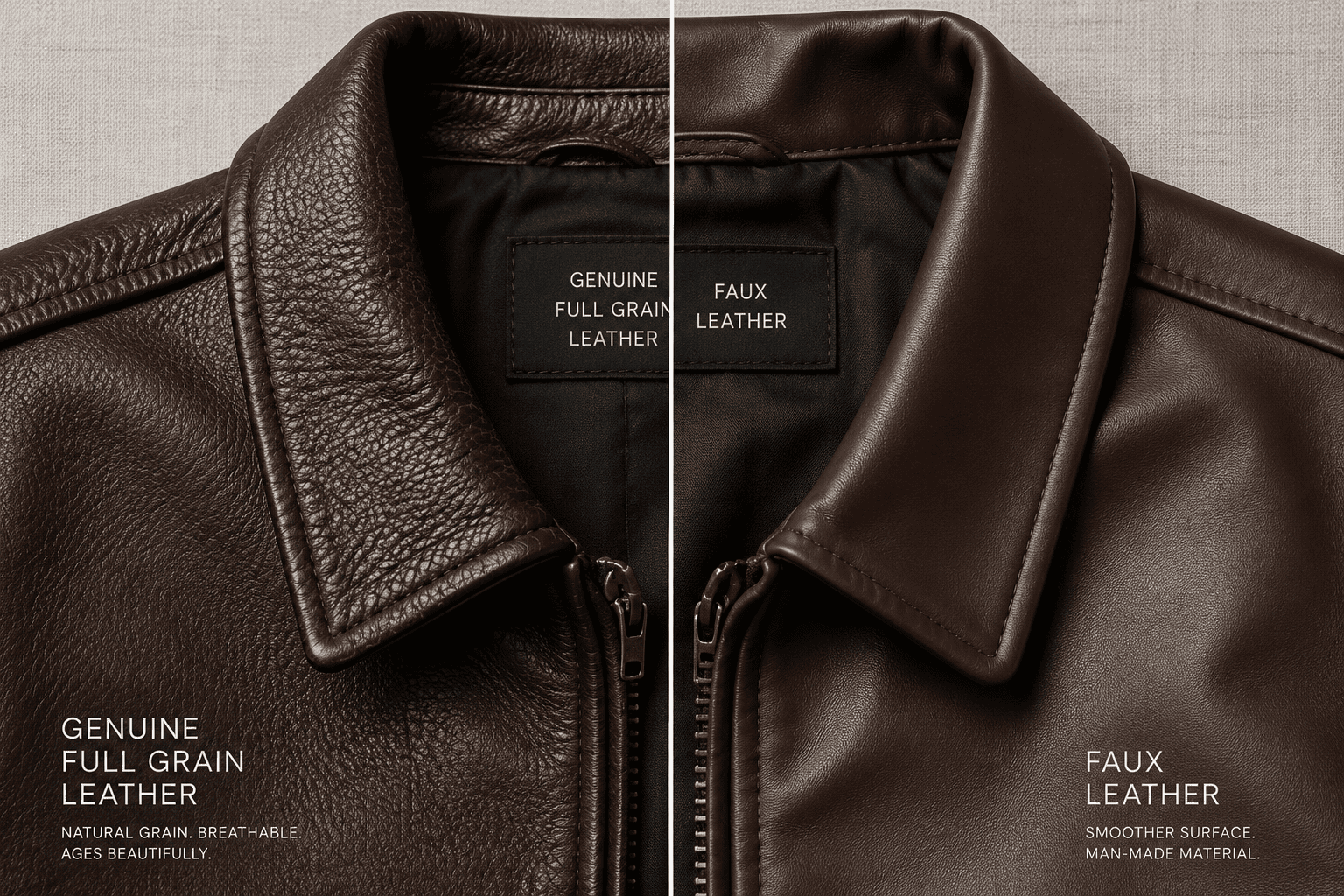
Full grain leather is the highest quality available. It uses the outermost layer of the hide with all the natural grain intact. It is the most durable, develops the best patina over time, and is used in the finest jackets in the world.
Top grain leather has been sanded or buffed to remove surface imperfections. It is slightly less durable than full grain but still excellent quality and more uniform in appearance.
Genuine leather on a label actually means the lowest quality real leather. It is made from the inner layers of the hide after the top grain has been split off. It is real leather technically but it is not what most people imagine when they think premium.
Bonded leather is the bottom of the real leather barrel. It is made from scraps and leftovers bonded together with adhesive. It behaves more like faux leather than real leather in terms of durability.
What Is Faux Leather?
Faux leather goes by many names including vegan leather, synthetic leather, pleather, PU leather, and PVC leather. It is an entirely man made material designed to replicate the look and feel of animal leather.
Most faux leather jackets are made from either polyurethane or PVC coated onto a fabric backing. Newer versions include plant based alternatives made from materials like cactus, mushroom, apple waste, and pineapple fibers. These are marketed as sustainable vegan leather alternatives.
Real Leather vs Faux Leather: 7 Key Differences
1. Durability and Lifespan
This is where the gap is biggest and most important.
A quality full grain leather jacket will last 20 to 30 years with basic maintenance. It gets stronger and more beautiful with age. The natural fibers in genuine leather are incredibly resilient and flex with your body without cracking or peeling.
A faux leather jacket typically lasts 2 to 5 years before it starts showing significant wear. The plastic coating on polyurethane and PVC materials begins to crack, peel, and flake with regular use especially at high friction points like elbows, collar edges, and zipper areas.
Winner: Real leather by a significant margin
2. Feel and Comfort
Genuine leather breathes. The natural pores in real leather allow air circulation which means it does not trap heat and sweat the way synthetic materials do. It also softens and molds to your body shape over time becoming more comfortable the longer you own it.
Faux leather does not breathe at all. It can feel sticky and uncomfortable in warmer weather and stiff and plastic like in cold weather. It does not soften or break in with wear the way real leather does.
Winner: Real leather for comfort, faux leather if you run very hot and prefer a stiffer structure
3. Appearance and Aging
Fresh out of the box a high quality faux leather jacket can look surprisingly close to real leather. The difference becomes obvious over time.
Real leather develops a patina, a natural deepening and enriching of color and texture that makes the jacket look progressively better with every year of wear. Scratches on real leather often buff out or become part of the jacket’s character.
Faux leather does the opposite. It starts looking worse over time as the coating cracks and peels. Scratches on faux leather are permanent and cannot be repaired.
Winner: Real leather
4. Price and Upfront Cost
This is where faux leather wins clearly. A quality faux leather jacket costs anywhere from $50 to $200. A genuine leather jacket from a reputable brand starts at around $200 and can go well into the thousands for premium full grain hides.
However when you factor in cost per wear over the lifespan of each jacket the math flips completely. A $300 real leather jacket worn weekly for 15 years costs less than $0.40 per wear. A $100 faux leather jacket that lasts 3 years costs more per wear and ends up in landfill.
Winner: Faux leather for upfront cost, real leather for long term value
5. Sustainability and Ethics
This is the most nuanced category of the comparison.
Faux leather avoids animal products which is important for vegans and those concerned about animal welfare. However most synthetic leather is made from petroleum based plastics that are not biodegradable and contribute significantly to microplastic pollution. When a faux leather jacket reaches the end of its short lifespan it sits in landfill for hundreds of years.
Real leather is a byproduct of the meat industry. The tanning process does use chemicals that have environmental impact. However genuine leather is a natural material that biodegrades over time and lasts far longer reducing overall waste.
Plant based leather alternatives made from cactus, mushroom, or pineapple are the most genuinely sustainable option but are still limited in availability and durability testing.
Winner: Depends entirely on your personal values. Neither option is perfectly clean.
6. Maintenance and Care
Real leather requires regular conditioning every three to six months, occasional cleaning with a damp cloth, and proper storage on a padded hanger away from direct sunlight. It responds well to care and rewards the effort with decades of great wear.
Faux leather requires almost no maintenance. Wipe it down with a damp cloth and you are done. However no amount of maintenance will stop the inevitable peeling and cracking that comes with age.
Winner: Faux leather for ease of maintenance, real leather for results of maintenance
7. Smell and Texture
Real leather has a distinctive rich smell that most people find deeply satisfying. The texture feels warm organic and slightly varied across different panels. No two pieces of genuine leather feel exactly the same.
Faux leather has a plastic or chemical smell when new that fades over time. The texture is uniform and smooth with no natural variation. To an experienced hand the difference is immediately obvious.
Winner: Real leather for sensory experience
So Which One Should You Actually Buy?
Here is the honest answer broken down by situation:
Buy real leather if:
- You want something that lasts more than five years
- You wear jackets regularly and want them to improve with age
- You are willing to spend more upfront for long term value
- You appreciate the feel texture and smell of natural materials
- You want a jacket that can be repaired and restored
Buy faux leather if:
- You are on a tight budget right now
- You are vegan or avoid all animal products on principle
- You want a trendy style that you may not wear in three years anyway
- You are buying for a child or teenager who will outgrow it
- You need a jacket for occasional wear only
Frequently Asked Questions
How can you tell the difference between real leather and faux leather?
The easiest way is to look at the back of the material. Real leather has a rough fibrous suede like backing. Faux leather has a fabric or mesh backing. You can also press your thumb into the surface. Real leather will wrinkle and stretch naturally. Faux leather tends to stay rigid or spring back immediately without wrinkling.
Does faux leather crack and peel?
Yes. This is the most common complaint about faux leather jackets. The polyurethane coating begins to crack and peel after two to four years of regular wear especially at high movement areas like the elbows inner sleeves and collar. Once it starts peeling it cannot be stopped or repaired effectively.
Is faux leather waterproof?
Faux leather is more water resistant than real leather in the short term because the plastic coating repels moisture. However real leather treated with a conditioner or protector spray handles everyday rain just as well and does not suffer the same long term degradation issues.
Can you repair a real leather jacket?
Yes. A professional leather repair specialist can fix scratches, tears, fading, and even replace panels on a genuine leather jacket. This is one of the biggest long term advantages of real leather. Most repairs extend the jacket’s life by many more years at a fraction of the cost of a new jacket.
What is PU leather and is it real leather?
PU stands for polyurethane. PU leather is entirely synthetic and contains no animal hide whatsoever despite sometimes being marketed in confusing ways. It is a type of faux leather with a polyurethane surface coating over a fabric base. It is not real leather in any form.
Which leather jacket material looks most like real leather?
High quality full grain faux leather made with modern manufacturing techniques can look convincingly similar to real leather at a glance. However plant based leathers made from cactus or mushroom currently have the most natural texture and drape of any synthetic alternative on the market.
Is genuine leather on the label always good quality?
No and this surprises most people. The term genuine leather on a product label actually refers to one of the lower grades of real leather. It is made from inner hide layers after the best parts have been removed. Full grain and top grain leather are the terms you want to look for when buying a quality jacket.
How long does a real leather jacket last compared to faux leather?
A well maintained full grain leather jacket lasts 20 to 30 years or more. Some people wear the same leather jacket their entire adult life. A faux leather jacket typically shows significant deterioration within two to five years of regular wear making real leather a far better investment over any period longer than three years.
Final Thoughts
The choice between real leather and faux leather ultimately comes down to how you prioritize your spending and your values.
If you want the best jacket you will ever own, one that gets better every year, fits your body perfectly after a few months of wear, and can be passed down to the next generation, genuine leather wins every single time.
If budget is the priority right now or animal products are a dealbreaker for you, a quality faux leather jacket from a reputable brand will serve you well for a few seasons.
Whatever you choose, the most important thing is buying from a brand that is honest about what you are getting.
At Marco Jacket every jacket in the collection uses premium full grain and top grain genuine leather. No bonded leather, no misleading labels, and no shortcuts on quality.